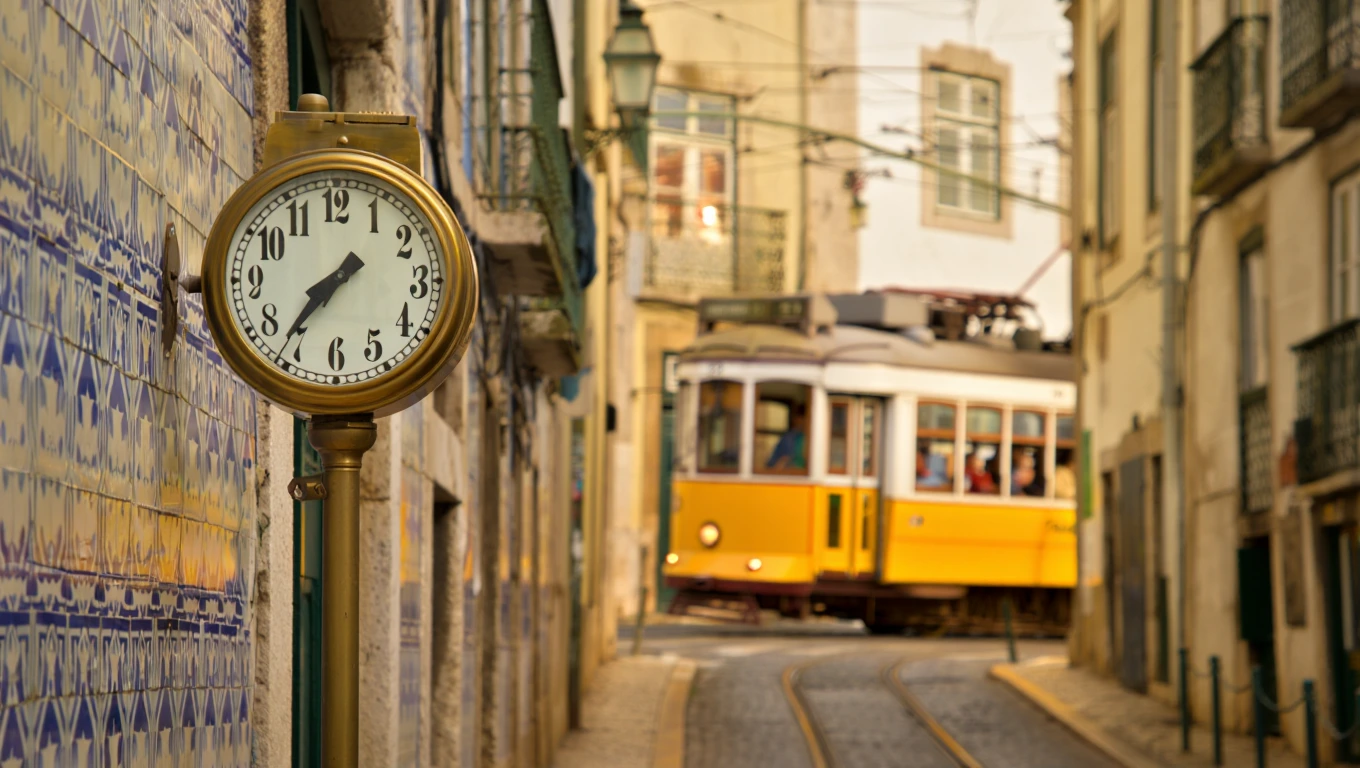
Sometimes my students tell me that asking about the time feels strangely intimidating. You can order a coffee, say “good morning,” even compliment someone’s dog — but the moment you need to ask “What time is it?”, everything suddenly disappears from your head. I’ve watched this happen countless times here in Lisbon. You’re standing at the bus stop, the sun is too bright, the 728 is definitely late again, and all you want is a simple phrase. But your brain goes blank.
In this article
So let’s fix that — gently, slowly, and with a bit of warmth.
This little guide is for anyone learning European Portuguese (not Brazilian) and wanting to feel confident when asking for the time or understanding the answer.
The simplest way to ask “What time is it?”
Let’s start with the phrase you’ll use 99% of the time:
👉 Que horas são?
- IPA: /kɨ ˈɔɾɐʃ sãw/
- Pronunciation: keh Ó-rahsh SOWN
- What time is it?
That’s it. Clean, clear, natural.
Why do we use ser?
Because in Portuguese, telling the time is considered a permanent or fixed fact — at least in the moment. So we use the verb ser, not estar.
How to tell the time in a natural, Portuguese way
Here’s the good news: the structure is incredibly logical.
Use são for most hours
São duas horas. → It’s two o’clock.
- Pronunciation (friendly): sown DOO-ash Ó-rahsh
- IPA: /sãw ˈduɐʃ ˈɔɾɐʃ/
São cinco e dez. → It’s 5:10.
- Pronunciation: sown SEEN-koo ee DEHZ
- IPA: /sãw ˈsĩku i ˈdɛʃ/
Use é only for one o’clock
É uma hora. → It’s one o’clock.
- Pronunciation: EH OO-mah Ó-rah
- IPA: /ɛ ˈumɐ ˈɔɾɐ/
Many English speakers mix these, and it always sounds a bit funny to us — not wrong enough to correct you, but unusual enough that we definitely notice.
The basic structure
São + hours + e + minutes
A few natural ways to say minutes:
15 → e quinze (or e um quarto, but the “quarter” is more formal)
- Pronunciation: ee KEEN-ze
- IPA: /i ˈkĩzɨ/
30 → e meia
- Pronunciation: ee MAY-ah
- IPA: /i ˈmɐjɐ/
Meia literally means “half.”
45 → menos quinze (or menos um quarto, less common)
- Pronunciation: MEH-noosh KEEN-ze
- IPA: /ˈmenuʃ ˈkĩzɨ/
Examples you’ll actually use
São três e quinze. → It’s 3:15.
- Pronunciation: sown TRAYSH ee KEEN-ze
- IPA: /sãw tɾejs i ˈkĩzɨ/
É uma e meia. → It’s 1:30.
- Pronunciation: EH OO-mah ee MAY-ah
- IPA: /ɛ ˈumɐ i ˈmɐjɐ/
São quatro menos quinze. → It’s 3:45 (literally “four minus fifteen”).
- Pronunciation: sown KWA-troo MEH-noosh KEEN-ze
- IPA: /sãw ˈkwatɾu ˈmenuʃ ˈkĩzɨ/
Time phrases you’ll hear every day (with translations + pronunciation)
Here are a few reliable examples you can use without hesitation:
São três horas. → It’s three o’clock.
- IPA: /sãw tɾejs ˈɔɾɐʃ/
- Pronunciation: SAUN trej-ZO-ras
É uma e quinze. → It’s 1:15.
- IPA: /ɛ ˈumɐ i ˈkĩzɨ/
- Pronunciation: EH OO-ma ee KEEN-zee
São quatro e meia. → It’s 4:30.
- IPA: /sãw ˈkwatɾu i ˈmɐjɐ/
- Pronunciation: SAUN KWA-troo ee MAY-ah
São sete menos dez. → It’s 6:50.
- IPA: /sãw ˈsɛtɨ ˈmenuʃ dɛʃ/
- Pronunciation: SAUN SEH-tee MEH-noosh DESH
São oito e vinte. → It’s 8:20.
- IPA: /sãw ˈojtu i ˈvĩtɨ/
- Pronunciation: SAUN OY-too ee VEEN-tee
If you want, make a small list on your phone and read it aloud when you’re waiting in line for your coffee. Repetition — short, regular, gentle — works wonders.
Asking for the time: polite, casual and very informal
You’ll hear different versions depending on the situation.
Polite (perfect for cafés, shops, strangers)
Desculpe, que horas são? → Excuse me, what time is it?
- Pronunciation (friendly): des-KOOL-peh, keh Ó-rahsh SOWN
- IPA: /dɨʃˈkuɫpɨ kɨ ˈɔɾɐʃ sãw/
Casual (friends, colleagues)
Sabes que horas são? → Do you know what time it is?
- Pronunciation: SAH-besh keh Ó-rahsh SOWN
- IPA: /ˈsabɨʃ kɨ ˈɔɾɐʃ sãw/
Very informal (street, metro, someone sitting next to you)
Tem horas? → Do you have the time?
- Pronunciation: TENG Ó-ras
- IPA: /tẽj ˈɔɾɐʃ/
This last one is wonderfully Portuguese — short, warm and very human.
Real-life dialogues (EN ↔ PT-PT)
On the street
Desculpe, que horas são?
IPA: /dɨʃˈkuɫpɨ kɨ ˈɔɾɐʃ sãw/
Pronunciation: des-KOOL-peh, keh Ó-rahsh SOWN
EN: Excuse me, what time is it?
Alternative: Tem horas?
IPA: /tẽj ˈɔɾɐʃ/
Pronunciation: TENG Ó-ras
EN: Do you have the time?
Answer: São cinco e vinte.
IPA: /sãw ˈsĩku i ˈvĩtɨ/
Pronunciation: SAUN SEEN-koo ee VEEN-tee
EN: It’s 5:20.
At a café
Sabes que horas são?
IPA: /ˈsabɨʃ kɨ ˈɔɾɐʃ sãw/
Pronunciation: SAH-besh keh Ó-rahsh SOWN
EN: Do you know what time it is?
Alternative (friendly, casual): Que horas são?/ Tens horas?
IPA: /kɨ ˈɔɾɐʃ tẽjʃ/
Pronunciation: keh Ó-ras TENSH
EN: What time do you have?
Answer: São quase três.
IPA: /sãw ˈkwazi tɾejs/
Pronunciation: SAUN KWAH-zee TRAYSH
EN: It’s almost three.
At work / office
A que horas é a reunião?
IPA: /ɐ kɨ ˈɔɾɐʃ ɛ ɐ ʁejuˈniɐ̃w/
Pronunciation: ah keh Ó-ras EH ah hey-oo-nee-OWN
EN: What time is the meeting?
Alternative: A reunião começa a que horas?
IPA: /ɐ ʁejuˈniɐ̃w kɔˈmɛsɐ ɐ kɨ ˈɔɾɐʃ/
Pronunciation: ah hey-oo-nee-OWN koh-MEH-sah ah keh Ó-ras
EN: What time does the meeting start?
Answer: É às dez.
IPA: /ɛ aʃ dɛʃ/
Pronunciation: EH ahsh DESH
EN: It’s at ten o’clock.
At a train station
A que horas é que parte o comboio?
IPA: /ɐ kɨ ˈɔɾɐʃ ɛ kɨ sɐj u kõˈboju/
Pronunciation: ah keh Ó-ras EH keh SAI oo kom-BOY-oo
EN: What time does the train leave?
Alternative (casual): A que horas parte o comboio?
IPA: /ɐ kɨ ˈɔɾɐʃ ˈpaɾtɨ u kõˈboju/
Pronunciation: ah keh Ó-ras PAR-tuh oo kom-BOY-oo
EN: What time does the train depart?
Answer: Parte às oito e quarenta.
IPA: /saj aʃ ˈojtu i kwaˈɾẽtɐ/
Pronunciation: SAI ahsh OY-too ee kwah-REN-tah
EN: It leaves at 8:40.
Common mistakes English speakers make (and how to avoid them)
I see these all the time — nothing dramatic, but easy to fix.
❌ Mixing é and são
Just remember:
- É → only for uma
- São → everything else
❌ Using Brazilian forms in Portugal
For example, in Brazil people often drop são:
- Que horas são? becomes Que horas?
In Portugal, we keep the full phrase.
❌ Translating English word-for-word
Students sometimes say:
“Que tempo é?”
Sadly, that means “What’s the weather like?”.
❌ Pronouncing horas with an English H
In Portuguese, the “h” is silent: oras, soft and airy. Don’t rush the sound. Let it fall out of your mouth naturally.
Useful related expressions you’ll meet everywhere
A que horas…? → At what time…?
- IPA: /ɐ kɨ ˈɔɾɐʃ/
- Pronunciation: ah keh Ó-ras
A que horas abre/fecha? → What time does it open/close?
- IPA: /ɐ kɨ ˈɔɾɐʃ ˈabɾɨ/ /ˈfɛʃɐ/
- Pronunciation: ah keh Ó-ras AH-bree / FEH-shah
É cedo / é tarde → It’s early / it’s late
- IPA: /ɛ ˈsedu/ / /ɛ ˈtaɾdɨ/
Pronunciation: EH SEH-doo / EH TAR-dee
Estou atrasado. → I’m late.
- IPA: /ɨʃˈtow ɐtɾɐˈsadu/
- Pronunciation: ish-TOH ah-trah-ZAH-doo
Once these expressions become familiar, everyday Portuguese feels much kinder.
A small practice moment (just for you)
Try translating these:
- It’s 2:30.
- What time does the train leave?
- It’s 1:15.
- Do you know what time it is?
- It’s late.
And now the other way around:
- São oito horas.
- A que horas abre?
- É uma e vinte.
- Tem horas?
- São quatro menos dez.
Don’t worry if you make mistakes — they’re part of the process. Read your answers out loud; your brain loves the connection between sound and memory.
Wrapping Up Your Time-Telling Journey
If you’ve read this far, you’ve already done something very Portuguese: you slowed down for a moment. Learning a language isn’t about being perfect. It’s about noticing, listening and enjoying the little pieces that suddenly make sense.
And this tiny corner of Portuguese — asking and telling the time — is one of those everyday joys. Keep going, keep repeating, and let the language become familiar in its own time.
If you’d like more guides like this, feel free to stay around. I’m always happy to help you fall a little more in love with LearnPortuguese.club